Drenajes quirúrgicos
Revisado por pares por Dr Hayley Willacy, FRCGP Última actualización por Dra. Rachel Hudson, MRCGPÚltima actualización 11 Feb 2023
Cumple con las directrices editoriales
- DescargarDescargar
- Compartir
- Language
- Discusión
- Versión en audio
- Agregar a fuentes preferidas en Google
Un drenaje quirúrgico es un pequeño tubo de plástico que a veces se utiliza después de una operación. El médico lo inserta en tu cuerpo durante la cirugía y permanecerá fuera de tu cuerpo hasta que sea retirado, generalmente unos días después. Se conecta a una pequeña bolsa de plástico que recoge cualquier líquido o aire que haya salido del lugar donde te operaron. No todas las operaciones requieren un drenaje: tu cirujano te informará si es necesario uno.
De un vistazo
A surgical drain is a small tube to help drain fluid or air after an operation.
They are usually small, flexible plastic tubes placed during surgery.
Drains can help prevent fluid build-up, pain, infection, and problems with healing.
They are not usually painful but may restrict movement.
Drains usually stay in for a few days until fluid production reduces.
What is a surgical drain?
Surgeons use small plastic tubes to help drain away fluid after an operation: without them the fluid might gather up and cause infection. Or, in the case of an operation on the lungs or chest, air might gather up and squash the lungs.
They are usually special small, flexible plastic tubes which the surgeon places during the operation and then leaves poking out your skin, attached to a small bag.
This is an example of a drain coming out of someone's leg:
Surgical drain
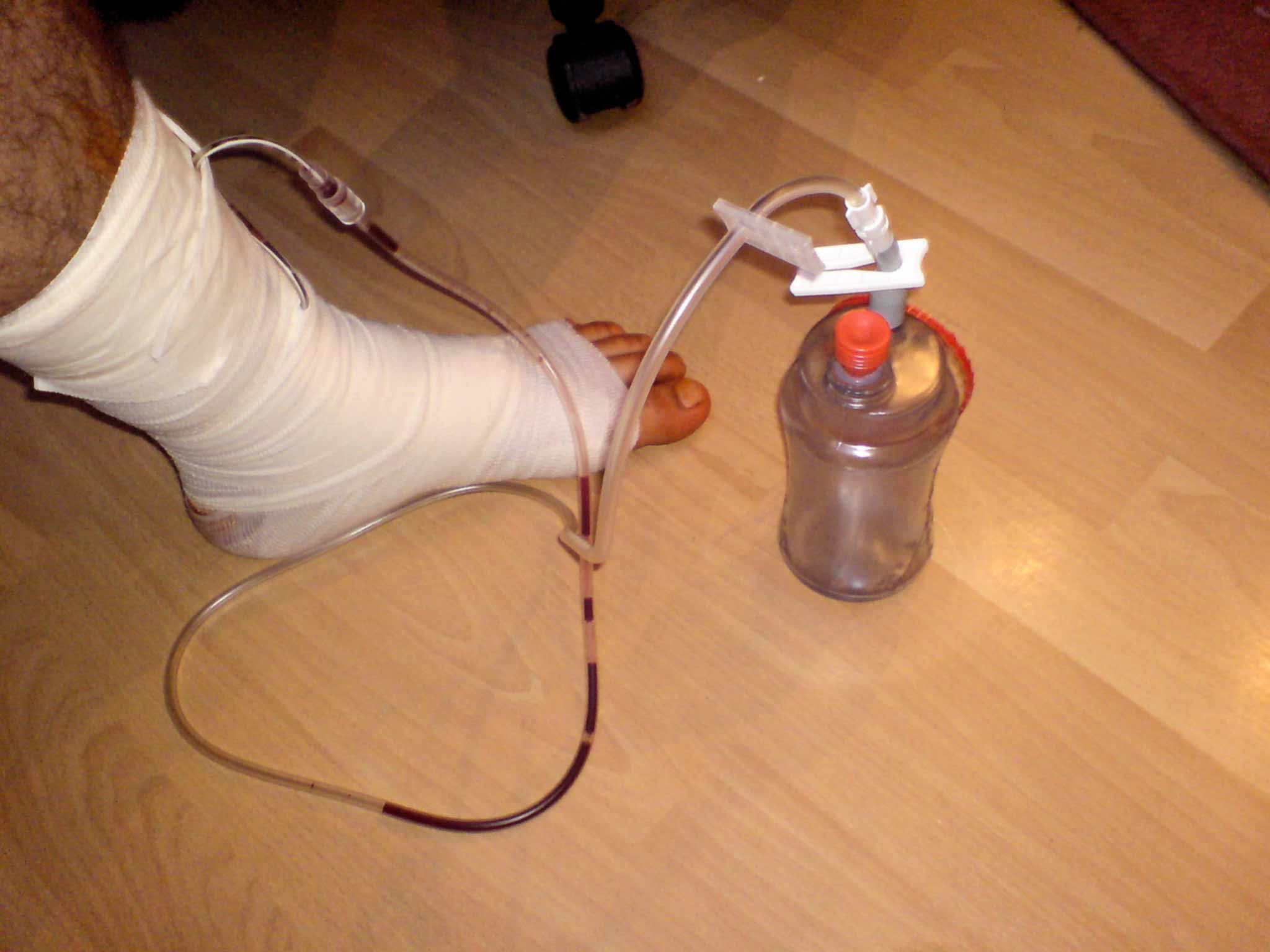
© ChristianKazur, Public domain, via Wikimedia Commons
Although they look a bit gruesome, they aren't usually painful.
Here's an example of a surgical drain after hand surgery:
Hand surgical drain
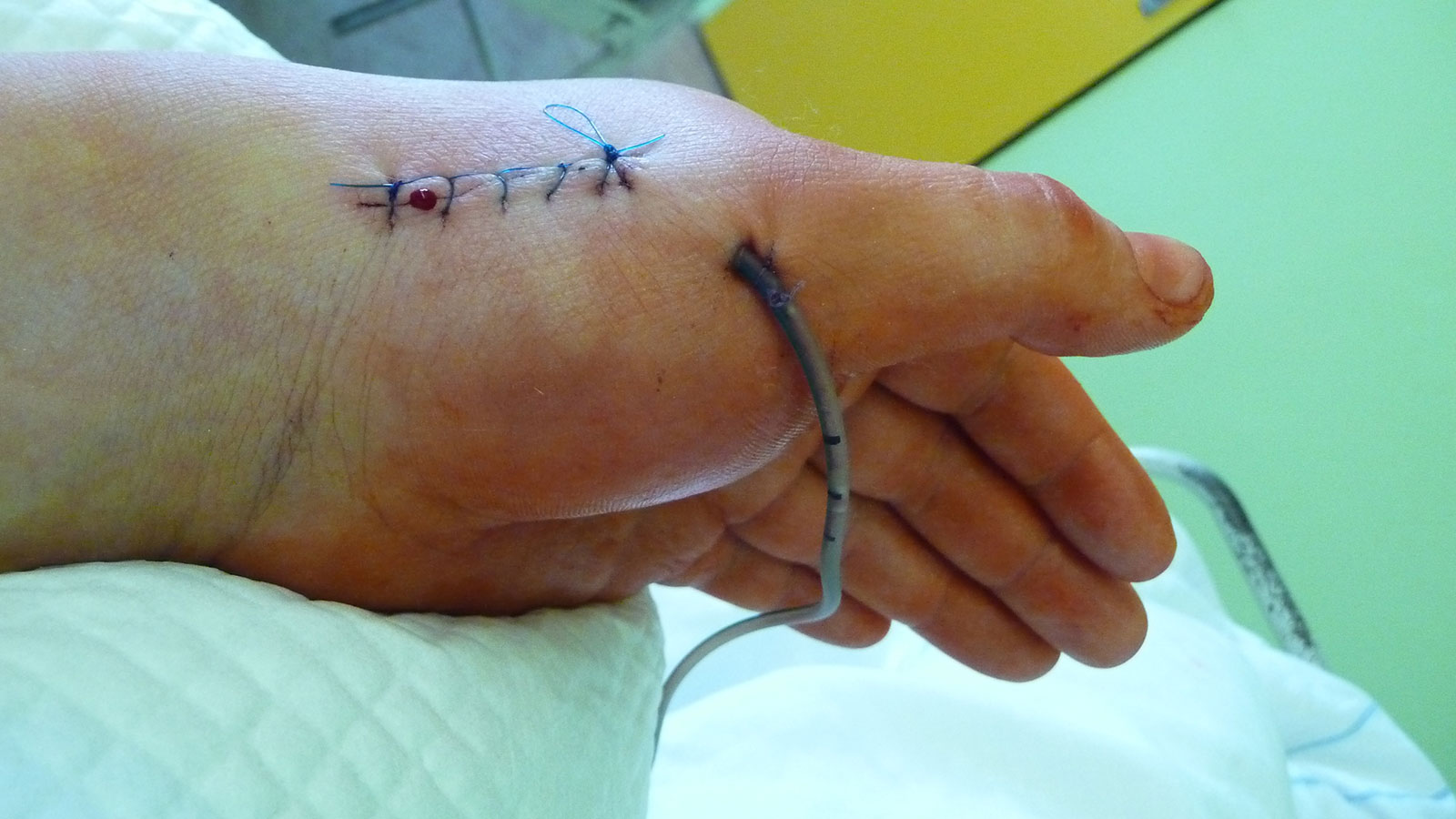
© Pavel Ševela, CC BY-SA 3.0,viaWikimedia Commons
How useful are surgical drains?
Some operations involve quite 'juicy' parts of the body: areas where the body usually makes lots of fluid or juices. An example would be surgery on someone's armpit (axilla): this is often done as part of breast cancer surgery. The armpit makes a lot of fluid after being operated on. Without a drain, the fluid might gather up in a large pool and be painful.
The pressure of the fluid inside might stop the wound healing properly. So the surgical drain allows extra fluid to drain off harmlessly.
If you have had to have an emergency operation - for example, for a burst digestive tract (what doctors would call a perforated bowel) - then there can be infected juices left behind inside you. A surgical drain allows those juices to drain away and hopefully reduce the chances of getting an infection after the operation.
How long do surgical drains stay in for?
Surgical drains usually stay in the body for a few days after an operation. When the fluid production has faded away, the drain can be removed painlessly.
Are there any drawbacks to surgical drains?
There are differences of opinion between surgeons as to whether surgical drains are always needed. Some studies have shown that they don't necessarily allow things to heal any faster. Other drawbacks include:
They can cause problems like infection around where the drain comes out; or they can interfere with things healing inside your body.
They can keep you in hospital longer.
Sometimes they can stop you moving around as much as you'd like, particularly if you have a drain from your chest area.
If they are left in for too long accidentally, they can be difficult to pull out and may leave a small tract which will take a while to heal up.
Which operations require a surgical drain to be fitted?
Operations around the neck, including on the thyroid gland.
Operations on the armpit (axilla).
Operations done in an emergency for something which has ruptured inside you.
Some types of brain surgery.
Operations on the stomach (the drain often then comes out your nose and is called a 'nasogastric tube').
Operations on the bladder (the drain then usually comes out the urine tube and is called a 'urinary catheter').
Your surgeon will discuss with you before the operation whether you will need a surgical drain and where it will be.
Selecciones del paciente para General surgery and procedures

Cirugía y procedimientos
Reemplazo de rodilla
Un reemplazo de rodilla es una operación para reemplazar las partes dañadas de la articulación de la rodilla. Puede ser un reemplazo total de rodilla (RT) o un reemplazo parcial (uni-compartimental) de rodilla. La nueva parte de la articulación se llama prótesis.
por la Dra. Philippa Vincent, MRCGP

Preguntas frecuentes
Do surgical drains always work effectively to prevent complications?
There are different opinions among surgeons regarding the consistent need for surgical drains. Some research indicates that they don't necessarily speed up the healing process. While they are designed to prevent fluid build-up and infection, their effectiveness can vary.
Can surgical drains limit my movement after surgery?
Yes, surgical drains can sometimes restrict your movement, especially if the drain is located in your chest area. This might prevent you from moving around as freely as you would like during your recovery period.
What happens if a surgical drain is left in for too long?
If a surgical drain is accidentally left in for an excessive period, it can become difficult to remove. Additionally, it might leave behind a small tract or tunnel in the skin that will take some time to heal completely after the drain is taken out.
Will having a surgical drain mean I have to stay in hospital for longer?
One of the potential drawbacks of having a surgical drain is that it can lead to a longer stay in the hospital. The drain usually remains in place until fluid production significantly decreases, which can extend the recovery time needed before discharge.
Are there different types of surgical drains, like ones that come out of the nose or urine tube?
Yes, while many surgical drains are small plastic tubes coming out of the skin, there are other types. For operations on the stomach, a drain might come out of your nose and is called a 'nasogastric tube'. For bladder operations, a drain usually comes out through the urine tube and is known as a 'urinary catheter'.
Lecturas adicionales y referencias
- Makama JG, Ameh EA; Surgical drains: what the resident needs to know. Niger J Med. 2008 Jul-Aug;17(3):244-50.
Sobre el autorVer biografía completa

Dr Oliver Starr, MRCGP
MBChB, BMedSc, MRCS, MRCGP, DRCOG
El Dr. Oliver Starr es un médico general en Hertfordshire y tutor de pregrado en la Escuela de Medicina de University College.
Acerca del revisorVer biografía completa

Dr Hayley Willacy, FRCGP
Médico General, Autor Médico
MBChB (1992), DRCOG, DFFP, MRCOG (Part 1) MRCGP (2007), DFSRH (2013), MSc - medical education (2020)
La Dra. Hayley Willacy fue una médica general del NHS que trabajaba en el noroeste de Inglaterra, quien se retiró de la práctica clínica en 2022 después de 30 años.
Historial del artículo
La información en esta página está escrita y revisada por pares por clínicos calificados.
Artículo también disponible en Inglés, Alemán, Español, Francés, Italiano, Portugués, Hindi, Hebreo, Árabe, y Sueco.
Próxima revisión: 10 Feb 2028
11 Feb 2023 | Última versión
18 Oct 2017 | Publicado originalmente
Escrito por:
Dr Oliver Starr, MRCGP

Pregunta, comparte, conecta.
Navega por discusiones, haz preguntas y comparte experiencias en cientos de temas de salud.

¿Te sientes mal?
Evalúa tus síntomas en línea de forma gratuita
Suscríbete al boletín de Patient
Tu dosis semanal de consejos de salud claros y confiables, escritos para ayudarte a sentirte informado, seguro y en control.
Al suscribirte aceptas nuestros Política de Privacidad. Puedes darte de baja en cualquier momento. Nunca vendemos tus datos.
Más sobre cirugía y procedimientos
- Complicaciones postoperatorias comunes
- Muerte o daño cerebral por anestesia
- Trombosis venosa profunda
- Aspiración con aguja transbronquial guiada por ultrasonido endobronquial
- Alivio del dolor epidural después de la cirugía
- Esterilización femenina
- Histerectomía
- Histeroscopia
- Reemplazo de rodilla
- Laparoscopia y cirugía laparoscópica
- Cirugía ocular con láser
- Depilación láser
- Cirugía de menorragia
- Daño nervioso después de una inyección epidural
- Prevención de infecciones después de una esplenectomía
- Embolia pulmonar
- Abdominoplastia
- Cirugía toracoscópica asistida por video
- Cirugía para perder peso