Why is my facial eczema worse in summer?
Peer reviewed by Dr Krishna Vakharia, MRCGPAuthored by Amberley DavisOriginally published 2 Aug 2023
Meets Patient’s editorial guidelines
- DownloadDownload
- Share
- Language
- Discussion
- Audio Version
- Add to preferred sources on Google
People prone to facial eczema can experience flare ups all year round, but for some, summer can bring on more bouts of irritation, red patches, and itchiness. If you find your face is affected more in the warmer months, you're probably prone to one or more of these common summertime triggers.
What is eczema?
Eczema, sometimes called dermatitis, is a condition that causes your skin to become inflamed. This results in red rashes and dry, flaky skin.
It also causes itchiness that leads you to scratch the area, which often breaks the skin and causes temporary bleeding, sores, and sometimes scars.
Not everyone experiences eczema on the face, but those who do can find it especially painful and uncomfortable, because the skin on your face is more sensitive.
What does eczema look like on the face?
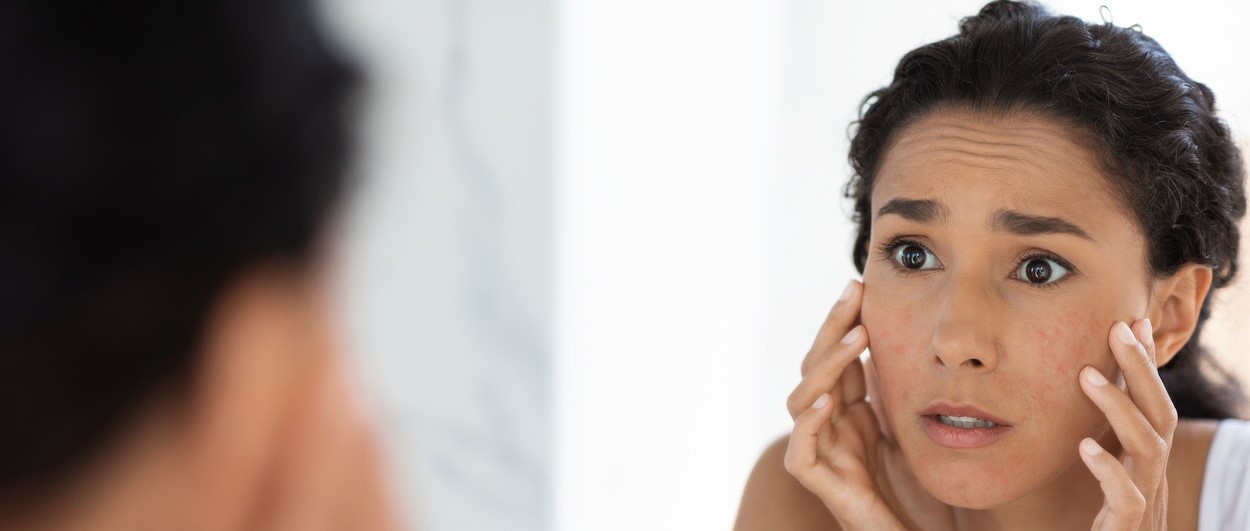
Facial eczema is most common on the cheeks and forehead. It may appear as red, purple, or white bumps, depending on your skin tone, and can also show up as a rash, dry flaky patches, or blisters.
Types and causes of facial eczema
The cause of eczema is not fully understood, but both genetics and the environment have a role to play. While there's no cure, symptoms tend to flare up for weeks at a time, go away, and then return.
As well as creams and medications, eczema on the face can be improved by knowing the environmental triggers that can kick-start your symptoms, and then taking steps to avoid or limit them.
Dr Mia Jing Gao, a skin specialist at the Cadogan Clinic, says: "some of the most common environmental triggers include fragrance, food, cosmetics, over-exfoliating, and using skincare that is too harsh."
Why is my facial eczema worse in summer?
A lot of people with eczema find winter to be a difficult time, but some experience their worst flare ups in summer. There are several possible triggers, including hay fever, sunlight, and warmer weather activities. We look at each type of facial eczema and the summertime environmental factors, habits, and activities that most commonly cause them to flare up.
1. Atopic dermatitis
Atopic dermatitis is the most common form of eczema. The word atopic means this eczema is an allergy, and if you have this condition, you're also more likely to have other allergen sensitivities, such as asthma and hay fever. Symptoms of atopic dermatitis on the face tend to show up around the forehead, cheeks, and eyes.
Common summer triggers:
Hay fever - if you have atopic dermatitis you are significantly more likely to suffer with hay fever. In turn, hay fever can be a trigger for eczema flare ups1.
High temperatures - if you have hay fever, a warm, windy day can blow pollen into the air and onto your face. Sweating in the heat can also aggravate eczema because sweat contains salts that can irritate broken skin2.
Swimming - chemicals used to treat pool water may irritate the skin.
Sunscreen - many sunscreen ingredients, especially in chemical sunscreens, can irritate sensitive skin3.
2. Seborrheic dermatitis
This is the most common type of facial eczema, and it also frequently appears on the scalp and chest. It's caused by an overgrowth of yeast on the skin, called Malassezia. If you have seborrheic dermatitis on your face, it's likely this appears around your hairline, eyebrows, and ears.
Common summer triggers:
Sunlight - while the sun's ultraviolet (UV) rays can kill this yeast, in some people sunlight is also a trigger4.
Heat and humidity - a change in climate, such as a heatwave, requires your skin to adapt. This can lead to an increase in sebum - an oily substance that prevents dry skin - and this could cause a flare up.
Summer depression or stress - seborrheic dermatitis is often preceded by a stressful event. If you experience the summertime blues, it's possible this can affect your skin.
3. Contact dermatitis
There are two types of contact dermatitis:
Allergic - where the facial eczema is triggered by the immune system as an allergic reaction to certain ingredients in skincare products or make up applied to the face, or even nail varnish on your nails if you touch your face afterwards.
Irritant - a non-allergic sensitivity to certain ingredients in these products. The immune system isn't involved, but the direct contact of a substance on the skin causes irritation.
Common summer triggers:
Sunscreens - some sunscreen ingredients can trigger an allergic or irritant response5.
Summer cosmetics - you might use different skincare products in summer that contain a triggering substance. This is also true of perfumes and hair dyes.
Swimming - your face may react if it's in pool water treated with chemicals for a long time.
Air pollution - hot weather can break down particles of dust, dirt, and smoke, and carry these on the wind so that they come in contact with your face and hands.
Plants - certain spring and summer plants, for example sunflowers, daffodils, tulips, daisies, and dandelions, can release particles that carry on the wind, land on your face and hands, and trigger flare ups6.
4. Light sensitive eczema
Light sensitive eczema is also known as photosensitive eczema and sometimes as sun allergy. In rare cases, the UV light emitted by the sun directly causes eczema. The skin usually reacts within minutes or hours, causing sunburn-like redness as well as well-defined rashes.
Common summer triggers:
Sunlight - this form of eczema is an issue all year round, and may include sensitivity to artificial light as well as sunlight, but in summer sun exposure is at its peak7.
How to treat eczema on the face
Managing your facial eczema at home
Dermatologist Dr Gao has these tips:
Use a gentle soap substitute to gently cleanse the skin.
Don't chop and change your skincare too much as that is likely to cause more irritation.
Avoid harsh skincare products - choose fragrance-free products which are suitable for eczema-prone skin.
Moisturise regularly - eczema skin tends to be very dry so it's important you keep it well hydrated with fragrance-free moisturiser.
Don't use hot water - ensure its lukewarm and don't vigorously scrub the skin.
Identify the triggers so you can avoid or minimise contact - keeping a journal is advisable to help monitor flares and identify triggers.
Medications and therapies
There are a range of over-the-counter moisturising creams with eczema-friendly ingredients, as well as cortisone cream to stop itching and inflammation. Cortisone cream is a steroid cream and should not be used on the face without discussing with a doctor first. Some steroid creams can make facial eczema worse.
If you find that over-the-counter ointments aren't doing enough to soothe your irritated skin, or if your facial eczema isn't responding to self-treatment, your doctor can recommend prescription medications or refer you to a specialist for other forms of treatment. This could include:
Prescription steroid creams.
Prescription antihistamines.
Tacrolimus and pimecrolimus creams to suppress the immune system for atopic eczema.
Biologics.
Light therapy.
Can you prevent facial eczema?
Eczema is an ongoing long-term condition, and you cannot completely prevent eczema on your face or anywhere on your body.
"Yet there are lots of things we can do to help treat it," says Dr Gao. "Consult a dermatologist for expert advice on treating eczema and to develop a management plan. They will also be able to help you establish a suitable skincare regime tailored to your personal needs."
Further reading
Patient picks for Eczema
Skin, nail and hair health
Eczema management plans: do they help control your eczema?
Poorly controlled eczema can make you or your child feel miserable, generally unwell, grumpy and uncomfortable, even if you don't have a flare-up. So it's not surprising that we're always hunting for something that will help relieve both flare-ups and day-to-day misery - and an eczema management plan could help do just that.
by Dr Sarah Jarvis
Skin, nail and hair health
Why is my facial eczema worse in summer?
People prone to facial eczema can experience flare ups all year round, but for some, summer can bring on more bouts of irritation, red patches, and itchiness. If you find your face is affected more in the warmer months, you're probably prone to one or more of these common summertime triggers.
by Amberley Davis
About the authorView full bio
Authored by

Amberley Davis
Senior writer
BA (Hons), CPD
Amberley is a senior writer with Patient and has written extensively on a range of health and wellbeing topics.
About the reviewerView full bio

Dr Krishna Vakharia, MRCGP
Chief Medical Officer for Health, Optum UK
MBChB, MRCGP(2013), BMedSci (hons), DFSRH, DRCOG, PGDipDerm (Distn)
Dr Krishna Vakharia is an NHS GP. She is also a regular examiner for the postgraduate Diploma in Practical Dermatology at Cardiff University as well as being the Chief Medical Officer for health at Optum UK.
Article history
Article also available in English, German, Spanish, French, Italian, Portuguese, Hindi, Hebrew, Arabic, and Swedish.
2 Aug 2023 | Originally published
Authored by:
Amberley DavisPeer reviewed by
Dr Krishna Vakharia, MRCGP
Join the conversation
Share your thoughts or experiences with others in our patient communities.

Ask, share, connect.
Browse discussions, ask questions, and share experiences across hundreds of health topics.

Feeling unwell?
Assess your symptoms online for free
Sign up to the Patient newsletter
Your weekly dose of clear, trustworthy health advice - written to help you feel informed, confident and in control.
By subscribing you accept our Privacy Policy. You can unsubscribe at any time. We never sell your data.