Los mejores entrenamientos con bandas de resistencia para desarrollar músculo
Revisado por pares por Dr Colin Tidy, MRCGPÚltima actualización por Lynn StephenÚltima actualización 28 Jul 2026
Cumple con las directrices editoriales
- DescargarDescargar
- Compartir
- Language
- Discusión
- Versión en audio
- Agregar a fuentes preferidas en Google
Resistance bands are a great way to improve the quality of your strength training routine. They can be incorporated into numerous exercises, adding extra force so that your muscles have to work harder to perform each task.
Do resistance bands work?
Although small, lightweight, and budget-friendly, many people still shy away from incorporating resistance bands into their fitness regimes. Part of the issue may be that their versatility - all the many ways resistance bands can be used on different parts of the body - make people unsure of where to start.
Scepticism over how well resistance bands can build muscle is also another factor, but they can be just as effective as using traditional free weights or weights machines.
How do resistance bands work?
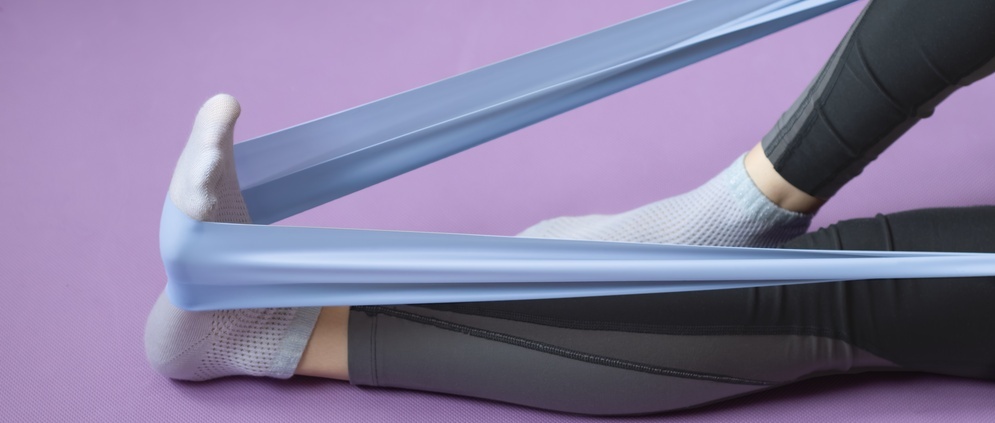
As the name suggests, these flat, stretchy elastic bands wrap around parts of your body - such as both your legs or arms - to add extra resistance while you hold or move these body parts away from each other.
Penny Weston, owner of the wellness centre MADE, explains that resistance bands are great for making your muscles work harder to stabilise and perform each exercise.
"They are also quick and simple to use. Storing them takes up no space which makes them easy to use at home, or on the move as you can just tuck them into your bag," she adds.
Exercises that incorporate resistance bands can be used for:
Strength building - as resistance bands place a force on your muscles when stretched tight.
Improving balance and mobility - they can help people of all ages improve balance and flexibility in their joints.
Improving your form - this comes from getting better at maintaining tension in the resistance band.
Weight lifting - wrapping resistance bands around the ends of a weight bar can increase bar velocity and power.
Injury rehabilitation - resistance bands can aid recovery for injuries that affect areas such as the knees, shoulders, and hips.
Do resistance bands build muscle?
Resistance band exercises are a great way to build muscle and strength. As Weston says, you can target almost every body part.
The effectiveness of building muscle with resistance bands has been demonstrated in many studies,1 including as part of a variable resistance training programme for athletes to increase power and strength.2
Performing a strength workout with resistance bands - with the band exerting extra force on targeted muscles, such as your leg muscles - can significantly improve the quality of each repetition (rep). This makes your workout routine more effective.
Laura Williams, fitness expert, says that speed and tension play a role in the effectiveness of your exercises too. A resistance band provides tension throughout the whole exercise - the slower you complete your rep, the more your muscles have to work.
"Bands come in different levels of resistance, enabling you to add or decrease intensity easily," she explains. "Varying from high intensity to low by using different strengths of band, for different exercises, will help you get the most out of an exercise."
The best muscle-building resistance band workouts
Williams explains that you can make a muscle-building resistance band workout effective by including a good variety of exercises.
"This could include both compound moves - those that target multiple muscle groups - and isolation exercises, which target single muscle groups," she says.
Weston recommends doing each strength workout with resistance bands for 45 seconds and then resting for 15 seconds.
"Try and complete four sets of each exercise too," she adds.
Bicep curls
Weston says: "This resistance band workout is a great way to build strength in those muscles that people often overdo with typical weights."
Sit on a chair or a step, tuck the band underneath your right knee, and hold it with your right hand.
Pull your hand up towards your shoulder against the resistance of the band. Keep your upper arm still as you pull on the band, and keep your elbow underneath your shoulder and close to your body.
Do around 10 repetitions on the right and then switch to the left side.
Russian twist
Weston says: "This is a brilliant exercise to work those obliques more effectively than with a medicine ball."
Sitting down, wrap the band around your feet. The band needs to stay taught the whole time.
Hold each side of the band with each hand and pull it up, lifting your legs off the ground - the higher you lift, the harder the exercise.
Your back must be at a 45-degree angle to the floor and your knees slightly bent.
Move your hands to one side and touch the floor and then twist to the other side.
Lateral raise
Weston says: "The lateral raise can be hard at first but is a good one to work the muscles in your upper back. It can enhance muscle growth but also increase your range of motion."
Stand in the middle of the band with your knees slightly bent, feet staggered with the right foot forward and flat on the floor.
Put your left foot back so that the resistance band sits underneath the arch of the right foot.
Hold the band with both hands and then raise your arms outwards until they are parallel to the floor.
Return slowly to your starting position. You can work this exercise up slowly.
Bicycle crunch
Weston says: "Using a resistance band takes this exercise to the next level and is brilliant for toning your midsection and slimming your waist."
Lie flat on your back with the resistance band wrapped around your feet.
Put your hands on the floor at your side and keep your lower back on the floor.
Pull your left knee in towards your chest at the same time as extending your right leg - while keeping it off the ground - as if you are cycling.
Reverse the position and keep pedalling.
Push-ups
Weston says: "This exercise will help develop your chest, triceps, and shoulder muscles all together. Using a resistance band will make your push-ups harder, and is much safer than trying to add traditional weights."
Start with the resistance band looped around your back and grip it in front with both hands.
Do your usual push-up but focus on driving your hands into the ground and then pressing your body upwards with as much energy as you can.
How often should you work out with resistance bands?
Weston cautions that resistance bands are not a quick fix to build muscle and you do need to do the exercises regularly.
There is no hard and fast rule - the frequency that you perform a muscle-building resistance band workout in your week can depend on your starting fitness level and fitness goals. This said, aim for at least 2-3 days a week in order to see long-term improvements.
Remember, it's perfectly natural to feel a little wobbly when you first start a muscle-building resistance band workout routine. It could take a little bit of time to get used to stretching the resistance band tight and to build up enough muscle to support this without shaking. However, with regular training, over time you will feel your strength grow and your form improve.
Selecciones del paciente para Ejercicio y actividad física
Vida saludable
¿Cuáles son los beneficios de los ejercicios de fuerza?
Cuando pensamos en ponernos en forma, la mayoría de nosotros imaginamos caminar, correr y otros ejercicios basados en el cardio. Aunque estas son excelentes maneras de mantenerse activo, muchos de nosotros tendemos a evitar los ejercicios de fuerza. Aquí, exploramos los muchos beneficios para la salud que pueden aportar.
por Lynn Stephen

Vida saludable
¿Qué es caminar con Tai Chi y vale la pena intentarlo?
El arte marcial del Tai Chi ha existido durante siglos. Originalmente desarrollado como una forma de combate defensivo, todavía sigue vigente hoy en día, aunque su mayor fortaleza ahora radica en su capacidad para apoyar la salud y el bienestar en general. Para algo tan antiguo, es impresionante que el Tai Chi siga encontrando una nueva relevancia en el mundo del bienestar actual. Una de las formas más recientes en que se está adoptando, especialmente en plataformas en línea, es a través de una adaptación más accesible de la práctica conocida como Tai Chi Caminando.
por Victoria Raw
Lecturas adicionales y referencias
- Mascarin NC, de Lira CAB, Vancini RL, et al; Strength Training Using Elastic Bands: Improvement of Muscle Power and Throwing Performance in Young Female Handball Players. J Sport Rehabil. 2017 May;26(3):245-252. doi: 10.1123/jsr.2015-0153. Epub 2016 Aug 24.
- Joy JM, Lowery RP, Oliveira de Souza E, et al; Elastic Bands as a Component of Periodized Resistance Training. J Strength Cond Res. 2016 Aug;30(8):2100-6. doi: 10.1519/JSC.0b013e3182986bef.
Sobre el autorVer biografía completa

Amberley Davis
Escritora senior
BA (Hons), CPD
Amberley es una escritora senior en Patient y ha escrito extensamente sobre una variedad de temas de salud y bienestar.
Acerca del revisorVer biografía completa

Dr Colin Tidy, MRCGP
Médico General, Autor Médico
MBBS, MRCGP, MRCP (Paediatrics), DCH
El Dr. Colin Tidy es un médico del NHS, con sede en Oxfordshire.
Historial del artículo
La información en esta página es revisada por pares por clínicos calificados.
Artículo también disponible en Inglés, Alemán, Español, Francés, Italiano, Portugués, Hindi, Hebreo, Árabe, y Sueco.
Next review due: 28 Jul 2029
28 Jul 2026 | Última versión
28 Abr 2022 | Publicado originalmente
Escrito por:
Amberley Davis

Pregunta, comparte, conecta.
Navega por discusiones, haz preguntas y comparte experiencias en cientos de temas de salud.

¿Te sientes mal?
Evalúa tus síntomas en línea de forma gratuita
Suscríbete al boletín de Patient
Tu dosis semanal de consejos de salud claros y confiables, escritos para ayudarte a sentirte informado, seguro y en control.
Al suscribirte aceptas nuestros Política de Privacidad. Puedes darte de baja en cualquier momento. Nunca vendemos tus datos.
Más sobre vida saludable
- Rompiendo el estigma de la salud mental
- ¿Funcionan realmente las dietas extremas para una pérdida de peso saludable?
- ¿La luna realmente nos afecta?
- Cómo ser feliz: 12 consejos para el día a día
- Cómo mejorar tu autoestima y ser más amable contigo mismo
- ActualizadoCómo evitar que los ronquidos arruinen tu sueño
- Cómo hablar con las personas sobre tu salud mental
- ¿Es el Pilates bueno para perder peso?
- Viajes LGBTQ+: cómo mantenerse seguro
- Efectos del tabaquismo en la piel: desde el envejecimiento hasta las enfermedades
- Las mejores aplicaciones de mindfulness, según los expertos
- La mejor manera de deshacerse de una resaca
- Las señales de advertencia de un problema con la bebida
- ¿Cuáles son los beneficios del Pilates postnatal?
- ¿Cuáles son los mejores ejercicios con bandas de resistencia para piernas?
- ¿Qué es la 'buena salud mental'?
- ¿Por qué no puedo dormir? 12 causas comunes y qué hacer
- Por qué pasar tiempo al aire libre puede mejorar tu salud