Peak flow meter for asthma
Peer reviewed by Dr Philippa Vincent, MRCGPLast updated by Dr Doug McKechnie, MRCGPLast updated 20 Jan 2025
Meets Patient’s editorial guidelines
- DownloadDownload
- Share
- Language
- Discussion
- Audio Version
- Add to preferred sources on Google
In this series:AsthmaAsthma inhalers
This leaflet provides information about the peak flow meter which is used by some people with asthma.
At a glance
A peak flow meter measures how fast you can blow air out of your lungs.
It is a small device that your doctor may prescribe if you have asthma.
You need to blow into the device three times, and record the best score.
Peak flow varies by age, size, and sex, and a normal range is found on a chart.
It can help diagnose asthma and monitor how well your asthma treatment is working.
A peak flow diary helps record measurements over time to show patterns.

What is a peak flow meter?
A peak flow meter is a small device that you blow into. It measures the fastest rate of air (airflow) that you can blow out of your lungs. It records airflow in litres per minute(L/min) and provides you with a score, which is called peak expiratory flow rate (PEFR). Your doctor may prescribe a peak flow meter for you if you have asthma. There are different brands of peak flow meter. They all do the same job.
How to use a peak flow meter
Your doctor, nurse or other healthcare professional will show you how to take a peak flow test. It is important to do this correctly; otherwise, the readings can be misleading. Briefly, you must:
Put the marker to zero.
Take a deep breath.
Close your lips around the mouthpiece.
Then blow air out of your lungs as fast as you can into the device. Note the reading. The further reading section has a link to an Asthma UK website which has a video showing how to use a peak flow meter.
When checking your peak flow score, you should do three blows, one after the other. The 'best of three' is the reading to record.
Common mistakes
When you do three blows straight after each other, the readings should all be about the same. If they are not, you may not be blowing into the device correctly.
A common error is to not to blow as hard as you can.
Another common error is to not put your lips right round the mouthpiece to make sure that all the air you blow out goes through the device.
Peak flow meter normal range
Normal peak flow readings vary, depending on your age, size, and sex. The range of normal peak flow readings is published on a chart, and doctors and nurses refer to the chart when they check your peak flow reading.
Knowing your personal best peak flow is also important, and helps you to know what you should expect.
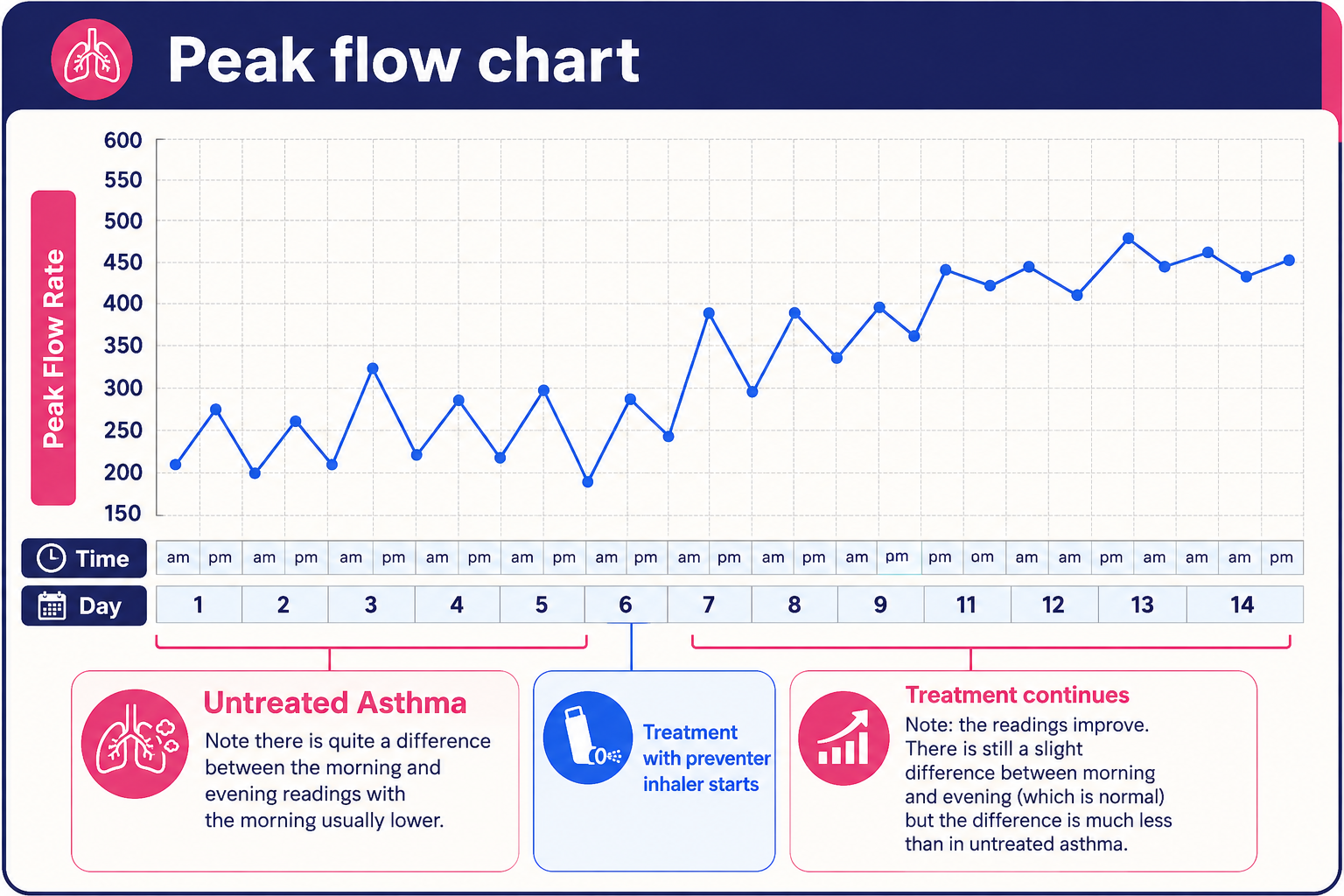
Normally, in healthy people, peak flow readings vary slightly from time to time. The reading is often slightly higher in the evening compared with the morning.
Peak flow graph
What are peak flow meters used for?
To help diagnose asthma
If you have untreated asthma:
Your peak flow readings will usually be low. No matter how strong you are, if your airways are narrowed, your peak flow will be lower than expected for your age, size, and sex.
Your peak flow readings will tend to vary quite a lot. Typically, the readings are lower in the morning compared with the evening. This difference is much greater in people with untreated asthma than the normal small variation seen in most people.
Sometimes a doctor or nurse will give you a chart (like the one above), and ask you to keep a record of your peak flow readings for a week or so. You will normally be asked to take a 'best of three' peak flow reading each morning and evening. This information can be used to inform your asthma action plan and help doctors make decisions to alleviate asthma symptoms or prevent asthma attacks.
Sometimes a peak flow reading is done before and after you take a dose of asthma medicine to open up your airways. If the treatment causes a large improvement in your reading, this too is typical of asthma.
To monitor treatment
For some people, keeping a peak flow diary can be a good way to monitor how well their asthma is controlled.
This is particularly useful for people who otherwise find it difficult to tell if their asthma is getting worse.
Peak flow meter diary
A peak flow meter diary is a way of recording your peak flow measurements over time. A one-off reading is usually not very useful, but seeing the pattern of how your peak flow measurements change over time can be very helpful.
See the peak flow diary leaflet for an example.
Patient picks for Asthma

Chest and lungs
Asthma
Asthma is a common condition that affects the airways. The typical symptoms are wheeze, cough, chest tightness, and shortness of breath. Symptoms can range from mild to severe. Treatment usually works well to ease and prevent symptoms. Treatment is usually with inhalers. This leaflet gives a general overview of asthma. There are other separate leaflets in this series.
by Dr Doug McKechnie, MRCGP
Chest and lungs
Asthma inhalers
An inhaler is a device containing a medicine that is taken by breathing it in (inhaling). Inhalers are the main treatment for asthma and help to control asthma symptoms. There are many different types of inhaler. This leaflet gives information on the medicines inside inhalers, the types of inhaler device and some general information about inhalers. This leaflet is only about inhalers for asthma. It is important to recognise that the same inhalers can be used in other medical conditions (for example, chronic obstructive pulmonary disease) but that the way they are used may be different.
by Dr Doug McKechnie, MRCGP
Frequently asked questions
When should I measure my peak flow?
If you are using a peak flow meter to help diagnose asthma, your doctor or nurse will typically ask you to record your 'best of three' peak flow readings each morning and evening for about a week. This helps them understand the pattern of your readings and inform your asthma action plan.
What if my three peak flow blows are not similar?
If you do three blows in a row and the readings are not about the same, it might mean you are not blowing into the device correctly. Common errors include not blowing as hard as you can or not sealing your lips properly around the mouthpiece so that all the air goes through the device.
Why is keeping a peak flow diary useful?
A peak flow diary helps monitor how well your asthma is controlled by tracking your measurements over time. A single reading isn't very informative, but seeing the pattern of changes over days or weeks can be very helpful, especially if you find it hard to tell if your asthma is worsening.
Can a peak flow meter be used to monitor my asthma treatment?
Yes, for some people, regularly recording their peak flow in a diary can be a good way to monitor how effectively their asthma treatment is working and whether their asthma is well-controlled. This is especially helpful if you struggle to recognise when your asthma is getting worse.
How does asthma affect my peak flow readings?
If you have untreated asthma, your peak flow readings will typically be lower than expected for someone of your age, size, and sex, due to narrowed airways. Also, your readings will tend to vary significantly, often being much lower in the morning compared to the evening, more so than the small variations seen in healthy individuals.
Further reading and references
- Global Initiative for Asthma (GINA)
- Asthma: diagnosis, monitoring and chronic asthma management (BTS, NICE, SIGN); NICE guideline (November 2024)
- Peak flow; Asthma UK, 2020
About the authorView full bio

Dr Doug McKechnie, MRCGP
Medical Writer
MA, MBBS, MSc, DRCOG, MRCP(UK), MRCGP(2021), FHEA
Dr Doug McKechnie is an NHS GP working in London. He works full-time clinically and is also the Deputy Lead for the Clinical and Professional Practice module at University College London Medical School.
About the reviewerView full bio

Dr Philippa Vincent, MRCGP
General Practitioner, Medical Author
MB BS, Bsc, MRCGP (2000), DCH, DFSRH, DRCOG
Dr Philippa Vincent is an NHS GP working in North London.
Article history
The information on this page is written and peer reviewed by qualified clinicians.
Article also available in English, German, Spanish, French, Italian, Portuguese, Hindi, Hebrew, Arabic, and Swedish.
Next review due: 19 Jan 2028
20 Jan 2025 | Latest version
Join the conversation
Share your thoughts or experiences with others in our patient communities.

Ask, share, connect.
Browse discussions, ask questions, and share experiences across hundreds of health topics.

Feeling unwell?
Assess your symptoms online for free
Sign up to the Patient newsletter
Your weekly dose of clear, trustworthy health advice - written to help you feel informed, confident and in control.
By subscribing you accept our Privacy Policy. You can unsubscribe at any time. We never sell your data.